Tuesday, November 11, 2014

Rainy season begins

Rainy day transport
North American and European winters are cold. The water falls from the sky in shivery drops that soak the skin or icy tears that pile up in white drifts. Some people really like the change of seasons.

I'm not one of them. I spent my childhood in Winnipeg where minus 35-40oF/C is not uncommon in January or February. I've had about as much snow, ice, and freezing temperatures as I can stand.

So I'm happy to be in Bandung where wet season means similar temperatures all year around even when the rain pours down in torrents once or twice a day. If you get soaked, you don't feel like you've landed in the refrigerator.

Rain-dancing with a squeegee
We have rain inside the house as well as outside. We're trying to contact our landlord who is mysteriously not taking calls. During the downpours, water sheets down the walls and drips from the ceiling in several rooms. My husband bought a long-handled 2-foot-wide floor squeegee so he can move the inches of water from the tiles through the door to outside. Obviously several rooms are not habitable.

But we weren't able to live in those rooms anyways. Not only is there rain inside, but there are migrating termites (that look like flying ants) as well as white larvae inside several ceilings. Several kitchen doors had to be removed (smell and destruction) and the cutlery drawer falls off its glides when we open it. The covered porch is losing its eaves, crumbling down under the rain and termites, so we haven't been able to sit there either.

We were pleased when the landlord hired someone to fix things. About halfway through the house, he said that was enough. Too much money? We are paying a generous rent a year in advance. So we are back to slapping to death the flying termites migrating back to the refinished part of the house. It needs a whole-house extermination company.
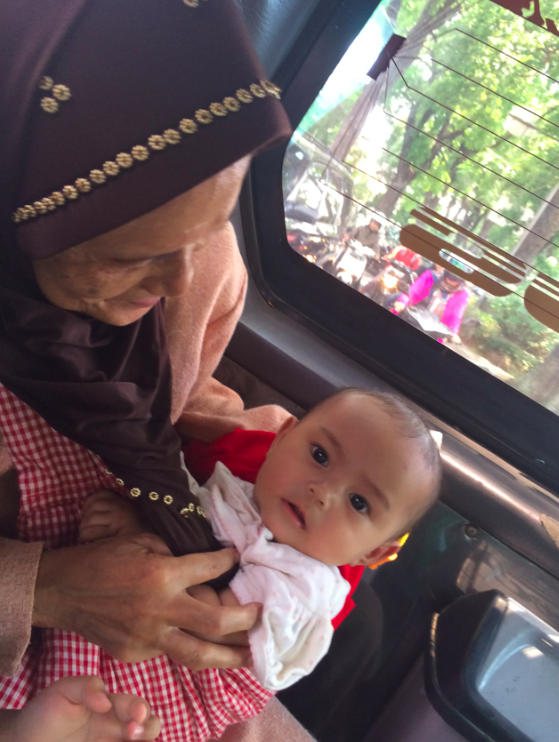
Beautiful people: a grandma and
granddaughter on the angkot
That said, we like the place and signed a 2-year lease. Therefore we'll be fixing it up. The repair bill will come off next year's lease payment. Sadly, it's going to cost the landlord much more than he could have fixed it for. We will, according to our contract, add rental time equal to the the amount of house we can't yet use, and it's been 3 months. We'll likely be charged more for ceiling replacement and extermination services as bulés (European-style foreigners). Might not be the smartest way for the landlord to save money ... but that's what he's choosing for himself. Sigh.

Anyhow, the rain is warm, the people in Bandung are friendly, and the food is wonderful. We've met so many new friends. We love the city and are happy to be here.

Got a Bandung story to share? We'd love to hear it.

Friday, October 3, 2014

Angkot info for Bandung

You'll meet all kinds! A man wearing traditional
Sundanese clothing on the angkot
At the end of the post, I offer a gold nugget for students, locals, and travelers to Bandung, Jakarta, and Surabaya! (Skip to the bottom if you don't need tips about angkots, an easy travel option.)

Angkots are little vans that take us all over the city. They're designed for 10 passengers but we've been in angkots crammed with 16 adults. Good thing most people here are thin.

There are exceptions. The other day a chubby mama sat down partly on me. I couldn't move without being pushed into the doorway. So I sat still as her seat pad. I admit to happiness when someone got off so that she moved over onto her own hips and hind end.

We've been using an excellent online app to get around Bandung. It can be read in bahasa Indonesia or English to show us which angkots we need to get from one address to another. The moving maps are handy so that we know when to say, "Kiri" (or if we're whizzing along in the wrong lane and have to get off in a hurry, "Kiri-kiri!") Then the driver pulls over to the left (kiri) and we hop one step down through the open doorway onto the side of the street or into traffic. I've bumped my head a few times when the angkot is so crowded that I can't duck down far enough as I leave.

Angkots reflect their drivers. Some motors are in great condition.
Sometimes the interior and upholstery are kept in tip-top shape.
Other times ... not so much.
A few tips below, or scroll down immediately for the app:

  • You will owe the driver between Rp 2000 and 4000 (US currency: 17c-33c), depending on the length of your trip. 
  • Hop out, then pay through the passenger window. They'll let you know if it's not enough - and sometimes they'll ask for more than it's worth. After a while, you'll know what's enough. If it's more than Rp 4000, we act dumb and shrug.
  • Keep your wits about you and your goods - especially your mobile phones - stashed out of sight and reach. Pickpockets do good business on the angkots so don't flash your belongings.
  • Keep coin change on hand to tip into a hat when the violinists (guitarists, singers) who jump on and off finishing serenading you. You'll tip some because they're wonderful and others because you're happy they're leaving.
  • If you miss the angkot, don't worry. Another is just around the corner.
  • Before boarding, make sure you have the right angkot. Please read: 1) end points of the route (two locations are listed at the top of the windshield); and 2) the routing (i.e. belok = turn; lurus = straight; etc.) 
  • Be cautious about driver information. Sometimes they'll take you aboard for a half hour and drop you across the street from where you got in ... and point the other angkot that you should have caught in the first place. When that happens, we smile and pay anyway.
  • Angkots stop running about 6pm. You'll need a taxi home if you stay out after sunset. Exception: in the center of the city some drivers pick up extra money by working later.

My husband recently got an email from the developer of Bandung's angkot software. We were pleased to eat breakfast with him today. He lectures in a local university and has worked in computer science here and in Singapore. He's traveled to Europe and around Asia. Therefore, he's aware of how much visitors and locals appreciate information on how to get where they need to go. Check it out!

Waldemar wrote on TripAdviser as well as below:
Got to meet this morning with Pascal Alfadian, a programmer of the Angkot app for Bandung that helps us get around. Very pleasant and wide-ranging conversation, and my wife and I enjoyed chatting with him. I'm not precisely sure who all worked on this app, but it's terrific! Check out http://kiri.travel/, where you can do a web-based trip search, or get access to their mobile apps.
KIRI helps people travelling by means of public transport. Therefore saving both money and the environment at the same time. Tell us where you are and where to go, and we will tell you the transports you need to take.
KIRI.TRAVEL|BY PROJECT KIRI (KIRI)

Friday, September 12, 2014

Things we like about Bandung

In our first month, here are three things we already like about Bandung:

1. People
The people are generally friendly and helpful. They smile at our attempts to communicate - and ask about us, our family, and why we're here. They try hard to understand our questions or where we need to go.

Language school students: our cultural experience was making batik
Indonesians are generous. The Christian charities - which we know about - volunteer help, time, and money to the less fortunate. The Muslim collection bins for change at many shops seem to collect a good amount.

2. The neighborhood
Our neighbors hang out with each other. They sometimes wave at us and chat (as much as we can) when we go by. Our next-door neighbor would be someone I'd choose for a friend: she's smart, funny, and an individual who has chosen to be herself within a community that values conformity.

The view from our front door

3. The food
There's a great variety of Indonesian foods we haven't tried, but we're making good progress. We don't know enough yet to recognize the spices or tastes from different regions. Indonesians like to snack, eat meals, and share their finds. Food venues range from well-known restaurants to warungs (little eateries) to food carts.

Gado-gado: tofu and vegetables in peanut sauce
At night, people crowd their favorite spots to eat and chat. We've been told that anywhere crowds eat will be safe for us. In contrast, if a place is empty, locals know it's not worth risking a stomach ache or wasting money on bad food. Following that rule, we have stayed healthy and eaten some wonderful meals.

Something we're less excited about: BUGS

The 3" grasshopper in our bathroom.

Tuesday, July 22, 2014

Getting ready for the move

Our friends from Jakarta, Pastors Stefano and Livia, took us on a 3-day fact-finding trip to Bandung. Our tasks in the next few weeks are to:

  1. sign up for language school
  2. find housing
  3. experience the setting and people, praying grace and favor on them - and that we feel at home in this new city.
Rice bowl, leaves line the basket
We wonder if some of the best food in the world is made in Bandung. Over the three days, we especially enjoy Maxis and Roma Enak Enak, blown away with tasty menus. When the bill comes, we are astonished: we four eat for the expected price of two. 

Deeeelicious fish

Saturday:
We eat breakfast on the second floor, overlooking the hotel pool. It's shaded in early morning and I'm a warm-water swimmer. (They were doing maintenance on it when we arrived so the pool has just opened.) Two little boys splash into the pool from a Little Tykes slide. They stand at the top of the slide, jump over the sides into the water, and dive to the bottom of the 3.5 depth. 

Trying to imagine this breakfast view in the USA: no lifeguard,
no safety rails on the Little Tykes playspace...
The realtor and friend come by again at 10. We go to House #1, take a lot of pictures, and ask a lot of questions. 

Pastor Livia on the front porch
"What about the furniture?" I ask. There are multiple shelf units, 2 or 3 beds, lots of occasional tables, a dining set, and two living room ensembles.

"Come for supper" - a kitchen and dining area
"Think of the furniture as a bonus," smiles the realtor.

I ask him to check if the owner would be willing to let us live in it for a week and then remove the parts of the "bonus" that we didn't need? Could they clean before we get in? It has already been cleaned once, we're told. 
A place for company - entry / living room 1
When we look up at the high ceilings, a 6" lizard sits near the top. 

Can you spot the lizard?
"That's what the spots are on the sofa," says the realtor. (Oh, lizard poop. Where's the vacuum? We can take care of that in a jiffy.) Livia says we don't chase out those lizards: they eat mosquitoes and other bugs. Yay, a house lizard - a good sign. And the kitchen is open to the garage, which has vent slats open to the outdoors. Couldn't keep lizards out if we tried, I guess.

Back yard shade
Perhaps these things can be negotiated, the realtor says. We make an offer for a year-long lease but haven't heard back by Tuesday (today). Please pray with us; perhaps this is the place to begin.

In town, we eat another great lunch. Then it's a long drive back to Jakarta: 5.5 hours ... and S & L are still miles from their own place when they drop us off about 8pm. Pastor S has to preach in the morning, too. We pray together over the services tomorrow and the accomplishments of the weekend. We are grateful for the generous attention of the IES Jakarta group and our friends during this transition.

Classic BMW motorcycle in the hotel lobby

Saturday, May 3, 2014

Those "last times"

In the last few months, we've done a lot of "last things." Our goodbyes are bittersweet; we can only be grateful for the family, friends, and comforts we've enjoyed to date. We're thankful for:

  • great relationships. Those include our families: we like the people we grew up with. How rare is that? We'll miss our accountability groups, the Thursday night group, our ministry peers who hang in during opportunities and challenges, and all the guests who have come through our doors during our 30 years in Seattle.
  • satisfying work. W taught his final in-person NU class on Friday, after teaching courses there for 57 semesters. He played his accordion as a final "Bad Music Friday," to the cheers of his students. I've enjoyed mentoring, connecting, teaching, and writing among peers. We've loved meeting with churches and individuals who are our prayer partners and supporters.
  • professional meetings with peers. We said goodbye to hundreds of people at our final annual conference this week, in Vancouver WA. Some of them we'll never see again. They encouraged us to be wholehearted about going to Indonesia. W will miss his Friday and Saturday coffee meetings; I'll miss my Thursday peers and my writers' critique group. 
  • the "friends of Indonesia" who are helping us prepare. They've given us advice and assistance with vaccines, visas, and what to pack. They're helping us prepare by talking about location, weather, and resources. And they're encouraging us with their love for the people of Indonesia.
  • beautiful surroundings. This year in the remodeled basement has been a pleasure. Whenever we leave our "just enough" apartment, we walk alongside the woods behind the house. What a treat to see the seasons transform the forest, just as this last year is transforming us.


The list could be much longer. But mentioning even these few things make me happy. We are truly blessed. Truly glad for God's calling and the transition process that is separating us from the familiar can pulling us into the unknown future.